It's coming up soon! Tickets are available. Hopefully, given my health issues, I will survive the airplane trip in one piece in order to receive this distinguished award.
The New York City Anti-Violence Project (AVP) will hold its 13th Annual Courage Awards on Monday, November 9, 2009 at the W New York Ballroom at 541 Lexington Avenue, New York. The evening includes cocktails and a chefs' tasting and a program featuring the award presentation.
At this year’s event, AVP has the privilege of honoring Pulitzer Prize winning playwright Tony Kushner, author of Angels in America: A Gay Fantasia on National Themes and The Intelligent Homosexual's Guide to Capitalism and Socialism With a Key to the Scriptures, for his truthful and cutting edge political writing and analysis; Weblog creators Bil Browning (The Bilerico Project), Joe Jervis (Joe.My.God.), Pam Spaulding (Pam's House Blend) and Andy Towle (Towleroad), in recognition of the impact of LGBTQH weblogs have made in the fight for civil rights and against violence in our communities; and Clifford Chance US LLP, for their commitment to lesbian, gay, bisexual, transgender, queer and HIV-affected (LGBTQH) rights and extensive work on behalf of the communities AVP serves.
Date: Monday, November 9, 2009
Location: W New York Ballroom at 541 Lexington Avenue, New York
I posted this entry on the Blend, but it's probably more suitable to discuss my medical woes here, since PHB has become more of a political coffeehouse discussion space than a personal blog. It's about a forced transition as a result of my recent trip to the endo.
It has been surprising how much mail I've received here and on Facebook from readers regarding my open discussion about livingwithfibromyalgia, from diagnosis to living with it while doing this full-time blog and holding down a full-time job since 2004. I'm glad that others dealing with this found the research and descriptions of the condition to demystify it ("Fibromyalgia: when your brain is not your friend") useful. Anyway, it's been a difficult couple of weeks, the "miracle" of Cymbalta hasn't exactly worked out. It was doing the trick to reduce the fibromyalgia pain, but a different problem emerged that has been under pretty good control until the flares started coming back with a vengeance after being put almost 100% at bay by the drug. I was told to up the dose from 60 to 90mg. That gave some relief, but not much.
Some of my other "friends" (nearly life-long chronic illnesses) were getting into the mix, and they are clashing and interdependent in causing the misery on the playing field. First up to bat is my PCOS (Polycystic Ovary Syndrome), something I've had since about 13. What is it?
Polycystic ovary syndrome (PCOS) is the most common hormonal disorder among women of reproductive age. The name of the condition comes from the appearance of the ovaries in most, but not all, women with the disorder — enlarged and containing numerous small cysts located along the outer edge of each ovary (polycystic appearance).
Infrequent or prolonged menstrual periods, excess hair growth, acne and obesity can all occur in women with polycystic ovary syndrome. Menstrual abnormality may signal the condition in adolescence, or PCOS may become apparent later following weight gain or difficulty becoming pregnant. The exact cause of polycystic ovary syndrome is unknown. Women with polycystic ovary syndrome may have trouble becoming pregnant due to infrequent or lack of ovulation. Early diagnosis and treatment of polycystic ovary syndrome can help reduce the risk of long-term complications, such as type 2 diabetes, heart disease and stroke.
Well, the condition wasn't exactly a surprise, as my mother had it, but it "corrected" itself when she had me and my brother. Mine was accompanied by severe insulin resistance, also common with PCOS, making it extremely difficult to lose weight for many, I fall into that category. Or, rather, another "friend" was diagnosed officially a few years later -- insulin-dependent diabetes. I was the first in my family diagnosed. Once I was tagged, then the dominoes fell, my mom and dad had it (neither obese), my maternal grandmother, a maternal aunt, and probably more undiagnosed. I got all the crappy endocrinological genes, my brother, thankfully is free of diabetes.
My problem is the PCOS was working in concert to make it necessary to take a lot of insulin for it to work in my body. The flip side of the miracle of life-saving insulin is it often comes with weight gain as well. Yes, can't win. Both maladies made it very easy to eat very little and still gain weight (or rather, not lose it after I reached a setpoint). Only recently have I been dropping pounds, mostly after my gall bladder was removed, and before the fibromylagia kicked in. Lately I've been losing because my blood glucose levels were out of control.
Why? Not because I was shoving Snickers in my pie hole (I was reduced to eating a bowl of cereal for breakfast and an apple for lunch and salad and some protein for dinner) the numbers were topping 300 when they should have been 80-100), but because the excruciating pain of fibro (or any chronic pain) shoots your blood glucose numbers into the sky, you dump the sugar from the body that cannot be processed; in essence your body is feeding on itself. In my case this was confirmed when I began the Cymbalta; the pain ebbed, my sugar levels dropped dramatically and I felt like a new person.
Which brings us back to today. The long run of high blood sugars, plus the fact that I have had very insulin-resistant diabetes now for about 25 years, almost ensures some complications would come into play, even with decent control up to now Thankfully, my eyes are fine (no blindness risk), my kidneys are fine (those often fail for some with diabetes). My dance with doom is diabetic neuropathy.
Diabetic neuropathies are a family of nerve disorders caused by diabetes. People with diabetes can, over time, develop nerve damage throughout the body. Some people with nerve damage have no symptoms. Others may have symptoms such as pain, tingling, or numbness—loss of feeling—in the hands, arms, feet, and legs. Nerve problems can occur in every organ system, including the digestive tract, heart, and sex organs.
About 60 to 70 percent of people with diabetes have some form of neuropathy. People with diabetes can develop nerve problems at any time, but risk rises with age and longer duration of diabetes. The highest rates of neuropathy are among people who have had diabetes for at least 25 years. Diabetic neuropathies also appear to be more common in people who have problems controlling their blood glucose, also called blood sugar, as well as those with high levels of blood fat and blood pressure and those who are overweight.
In July I got an inadvertently inkling of how bad the nerve damage was when I visted the neurologist to exclude some other issues and he performed some tests on my feet.
Sensation/pain test: Using a sharp, pointed device he tried it on my foot and I could feel the pressure of the device poking me, but no pain or reflex to make me move my foot away. When he applied the same pressure up near my knee, it felt like a sharp needle. Way sharp as in it hurt and I jerked my leg away.
Cold sensitivity: He took a metal instrument and said to let him know what it felt like. He put it on the sole of my feet, asked if it was cold. It felt mildly cool, not uncomfortable. He did it on the top of my feet, felt a little cooler, still not remarkable. He put it up on my thigh and it felt like he had just taken it out of the freezer!
So today I went to see my FNP who is terrific, she and my endo have been working my case as long as I've been back here in Durham, so they've seen all the highs and lows as I've gone to neurologists, rheumatologists, primary care doctor changes, etc. over the years. The last 6 months have been the toughest slog by far. During this last bout with the insulin resistance/pain/high BG, the neuropathy in my feet made itself all too present on a daily basis. - almost all shoes hurt; - feet are burning at times every day; - sock seams hurt now; - numbness, can still sense, but hot/cold perception is almost non-existent; - feet unnaturally cold all the time (have to wear socks to bed, and thick socks during day).
All this is going on in addition to the fibromyalgia's disabling pain and almost-out-of-nowhere unnatural fatigue, like hitting a wall. We discussed various options to try to get my BGs down and address the pain; it's such a crap shoot, since there's no one magic bullet with this constellation of syndromes and diseases. You'd think that someone who never smoked, did drugs or even drinks more than a couple of times a year could get a break, but alas, no. I guess the half glass full is that if I did, I might be sitting on the operating table waiting for something to be amputated. But I digress...
So the threshold I crossed today with my FNP -- and she brought it up before I did -- was that it was time to apply for a permanent handicapped placard for my car. I didn't want to hear this. It's too soon to let these "friends" drag me to this place; however, she was frank with me about how I can only slow this by taking care of myself. It's just denial. I know I will adapt. I always have when several life curve balls have been tossed my way. I just have to be realistic, there is not an endless energy supply to run my feeble body and do what I have done each day since July 2004.
But as I sit here weary and wondering why I continue to burn the candles at both ends as my doctor tells me today that this pace is also directly contributing to my declining health, I find it amusing that there's a lot of criticism out there (and I do know who you are) that indy bloggers aren't "doing anything" for the movement (i.e. just spouting criticism from the keyboard). There is a blanket assumption out there that we're only bellyaching and not doing anything offline. I can only speak for myself, but what limited free time I do have I've managed to also:
speak to young people at gay-straight HS alliances to discuss what it is like to come out and to go out in the professional world;
give time, money, and energy to state organizations for their programs;
give and help raise funds to defeat anti-gay ballot initiatives;
use personal funds, vacation and sick time to travel to places to advocate for rights in Red states and to speak on panels about new media, the political landscape to enhance the fight for equality;
make the decision to take on even more work - to be the first out lesbian columnist for a major newspaper in NC in order to share with my neighbors that gay is OK.
That's all while still blogging and working, mind you.
These days I've had such difficulty getting out of bed -- literally -- that you've probably noticed less-frequent postings. The thought of the pain caused by traveling, lugging bags and the whole airline shuffle makes me loathe it now.
And, btw, I'm not special in any way; many other citizen journalists/activists do more than speak their minds about the movement's flaws and strengths. I guess what I'm really serving up is a big STFU with a swirl on top to those intimidated by these "accidental activists." Your privilege and access are not at risk -- we have been told that we don't know how anything works in the halls of power. So stop fretting and soiling your diapers. Life is too short, equality will come with or without you. Peace out.
On the bright side, I have to give an "I'm not worthy" to my fellow baristas who have been churning out great content while I've been down for the count way too much (and many of the Blender diaries have been stellar)! They are just as valuable as activists, as well as the loyal readers who create, shape and participate in online and offline actions to create change and hold bigots and politicians accountable. You're all worthy. We'll all keep fighting on.
'Taking the stage at Pride' is a short write up on what happened at NC Pride when I keynoted before a festive crowd, despite the rain. A snippet:
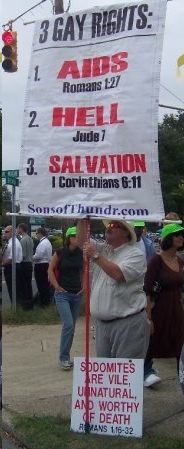
More than 4,500 people showed up to take in the speakers, entertainment and all the vendors. The crowd spanned all ages, races and religions. The many open and affirming local houses of worship far outnumbered the few tired protesters who showed up with their "turn or burn" signs.
In fact, one of the men who showed up with a giant sign saying "3 gay rights: AIDS, HELL, SALVATION" was an import from Primrose, Ga. -- Pastor Billy Ball, who has sent me repeated barely-tethered-to-reality hilarious e-mails over the years because of my blog, so his presence was for my benefit, I suppose. He wasted who knows how much gas driving up here for an hour-long parade.
...I talked about the LGBT community's inability to handle its own discomfort in dealing with race and religion, and the self-segregation that goes on that prevents mutual understanding. One good sign I saw was the many people of color who were present at Pride, particularly black and Latino members of the community.
NC Pride Keynote Address (as prepared for delivery)
Durham, NC (Duke East Campus)
September 26, 2009
Hi everyone -- it's a great gay day in the Bull City! Just a little too gray…
It's so strange to be standing up here rather than down there. I honestly wonder why I have been asked to address you today at NC Pride.
After all, I'm just a blogger, scratch that, citizen journalist. Back in July 2004 when I started Pam's House Blend, it was just a way for me to let off steam about the sad state of political affairs for the lesbian, gay, bisexual and transgender community under our last president.
You'll recall that the 2004 election year was an unending assault on our lives with professional anti-gay organizations working hard to ensure amendments passed in states to bar gay and lesbian couples from marrying. And passed they did at the ballot box, in Missouri, Montana, Mississippi, Alabama, Arkansas, Georgia, Kentucky, Louisiana, North Dakota, Ohio, Oklahoma, Michigan and Utah. A clean, depressing sweep.
What a difference five years makes, huh?! While Massachusetts has had marriage equality since May 2004, we have seen it blossom in CT, IA, MA, VT; NH (in 2010) and ME. We saw it flourish for a brief time in CA before it was voted away by mob rule with Proposition 8.
In fact, as we stand here today, we are trying to stop a massively bankrolled effort to repeal marriage equality in the state of Maine. Civil rights should never be determined at the ballot box, yet time and again, homophobia has driven people to believe that might makes right.
While marriage equality is important to me, and many of you out there, for those of us who live in NC and other states where there are few or no protections at the state level, the gains we seek are so modest, so essential, and happen all too slowly down here in the South. And that leads me to great news to report about our state. . . the gains in 2009:
Gains in 2009
* For the sixth year in a row, a proposed state constitutional marriage amendment was killed in committee. North Carolina is the last state standing in the South without an amendment. Give a cheer for that! We have to keep it at bay because the language in this discrimination amendment would not only deny same-sex couples marriage, but it would ban civil unions or any other kind of relationship recognition.
* The School Violence Prevention Actto address bullying and harassment in schools, including acts targeting LGBT students. It's sad that there was even opposition to this bill, which creates safe space for learning for all children. It marks the first time sexual orientation and gender identity are included in North Carolina law. I have to give a shout out to Equality NC; the organization received the "Most Amazing Achievement" award from the national Equality Federation because this is the first gender identity-inclusive law in the South!
* Another step forward is the passing of the Healthy Youth Act, that enables comprehensive sex education program in grades 7-9. Before this bill, abstinence-only education was the only option.
* The state held the line on funding for HIV prevention programs and the AIDS Drug Assistance Program will continue to provide low-income patients with the medicine they need.
* Second parent adoption and the welfare of children received a boost in a ruling this year by the North Carolina Court of Appeals.
* And last, but certainly not least, on August 17, the Durham City Council unanimously passed a Resolution in Support of Civil Marriage for Same Sex Couples. It was a measure submitted by resident Joshua Lee Weaver. Durham now joins Chapel Hill and Carrboroas the only cities in North Carolina that have passed such a resolution. Of course it carries no weight in terms of legal recognition, but it speaks volumes about how our city values our relationships and supports diversity. Thank you, Mayor Bell and members of the Council.
Hey Raleigh -- get on the stick - we need the other point in the Triangle covered! What's the hold up?
An aside -- that positive news is tempered by the fact that County Commissioners in at least 15 counties and one town have passed resolutions supporting a state Marriage Amendment.
While we're on the topic of that resolution, I want to talk about what I saw at the City Council meeting when it passed it. What I saw disturbed, but didn't surprise me.
This meeting drew a standing-room-only crowd to the council chambers. Many of my blog's national readers were looking for a first-hand account, so I was there to tape and Tweet it. I panned my camera to get a view of the crowd and suddenly noticed the racial divide in the room -- those who were standing and who remained seated. I didn't see any people of color standing or clapping in approval.
In fact most of them were seasoned citizens -- mostly black women who were stone-faced in disapproval. The reaction I saw made it clear that there is work to be done to build bridges in the community regarding LGBT equality, race, and religion. I wrote about this incident in The Durham News, fully expecting vigorous feedback on both sides; however it was met mostly by silence.
In hindsight, it shouldn't have surprised me. To discuss it would be like stepping on a landmine for many people.
It was equally eye-opening when longtime social justice activist Mandy Carter and I, along with several black gay and lesbian attendees, visited two members of the NC legislative black caucus during Equality NC's Day of action earlier this year. I will preface this by saying that these membersare strongly there for us on other pro-LGBT issues, but the matter of the state marriage amendment bill by some members of the black caucus is clearly a land mine. To our faces we were told by respected chair Rep. Alma Adams that LGBT issues are not "the caucus's issues" -- as in social justice issues -- and another Rep. Earline Parmon, who supports the marriage amendment bill, justified it by saying she is a minister.
That last statement sucked the air out of the room. To have an elected official answer a constituent's question by indicating she doesn't understand the separation of church and state; well, that's tragic. When I blogged about this, many asked how did we maintain our composure in the face of answers like this.
Honestly, when we left and sat down to talk about what we experienced, the shared feeling was how hurtful it was to be rendered "less-than" to our faces. I think the day taught us all a valuable lesson that spending "face time" with lawmakers to share our stories is essential, and for black LGBTs it's critical -- it's not an option to be rendered silent and invisible.
Affirming religion
Religion itself is not to blame for this; I want to note that it is wonderful to see so many houses of worship represented here today at the booths and in the parade -- give them a hand -- it's a beautiful sight to see so many affirming allies of faith here to counter the image of religious "bigotry by bullhorn" and "turn or burn" crowds who believe that hell and damnation await us.
The presence of these open and affirming houses of worship is proof that our side will win this fight for equality. The problem these anti-gay churches have is their myopic worldview -- they believe that there is only one Christian POV that should govern how all of us should live (never mind any other faiths, they don't think that far).
In the end, that limited thinking is going to sink the bible-based movement to deny us civil rights. Activists outside of the South often want to ignore or write off working for change in the region because it is steeped in religion; I think it's short-sighted. Many members of the LGBT community have indeed been so rejected and hurt by the hateful messages blasted from the pulpit that they reject faith. That's entirely understandable. But for many, they want to reconcile the faith and traditions they cherish in an environment that affirms they are human, that they are loved for who they are. And that's OK too.
When you encounter someone who cites their religious beliefs to justify opposing the civil right of gay and lesbian couples to marry, ask them a couple of questions. 1) Do you realize that unless the couple has obtained a marriage license issued by the state, a religious marriage means nothing in the eyes of the law? 2) Do they truly believe that there isn't separation of church and state in this matter? If so, they are effectively asking the state not just to prevent us from marrying on that basis,they are also affirming state discrimination against the churches and denominations that DO want to marry those same couples. That's discrimination based on religion and I hate to break it to them -- that isunconstitutional.
Those opposing equality haven't any other card to play except to say it will "change" the definition of marriage, as if it hasn't changed over time. Years ago, marriage meant women were the property of men. And then the definition of marriage changed.
Several generations ago, blacks couldn't marry a person of the same race (because we were property), let alone someone of another race -- and the bible was used to justify that. And then the definition of marriage changed.
It's painful to see people of faith cite passages in holy texts to justify oppression of LGBT people when the same public admonitions are rarely delivered to the adulterers, thieves, and fornicators sitting in the pews, or worse, the person standing in the pulpit.
I recently received an email from civil rights legend and head of the NAACP, Julian Bond. He said, quote:
I do not believe the battle for LGBT rights will ever be won until we can diminish the homophobia in black communities and until more in the black LGBT community join the battle openly.
I've often wondered what would be the result of black LGBT churchgoers standing up in the churches they attend and saying "I'm gay - you know me - I'm like you. I am what God made me. Why do you treat me so badly?"
I would like to see more black LGBTs in those churches muster the courage to do this. A culture has been affirmed in too many churches is that being gay or lesbian is so horrible that it's better to have a public heterosexual identity than deal with truth telling, even if the silence contributes to the skyrocketing HIV infections in the community. The silence is killing our people.
All that said, part of the reason the closets are so tightly shut in the black community is due to the fact that LGBT people of color in large part feel there is as much racism and sexism in the larger out gay community as there is in the straight community.
I have said many times on my blog that discussing racism within the LGBT community is an incredibly difficult endeavor; I try very hard to create a safe space for this. Most white people fail to engage, remaining silent out of fear of offending someone, or worse, reveal their own biases and working through them in public, even with the anonymity of the Internet.
For blacks and other minorities, who have to learn how to integrate in the dominant culture out of necessity, they are often feel frustrated and defensive hearing the lack of knowledge exposed when whites make the tentative steps to engage. The honest truth is that, outside of working alongside people of color, there's a lot of social self-segregation going on (on both sides).
What this lack of cross-community dialogue means for out LGBTs of color is that one has to be willing to put yourself out there to be attacked, over and over for addressing homophobia in communities of color knowing that few, if any, white LGBTs are going to come forward to have your back.
I see it time and again, with the excuses ranging from "I'll be called a racist" or "it doesn't feel safe to do this" or "it isn't my place to do it. " Well if you're waiting for it to be safe, it isn't going to happen.
The fantasy of a post-racial society with the election of Barack Obama as the first black president is just that, a fantasy. Just flip on the TV.
So it is in this environment that black LGBTs have a difficult choice about whether to come out, though more and more are. Fearful of losing social connections, friendships and emotional shelter provided by their faith community if they come out, black gays and lesbians in the church are intimidated.
They fear the judgment of those in the pews and the pastors spewing anti-gay bile from the pulpit. Some of these minority LGBTs simply cannot envision stepping out of the closet because they don't see a welcoming largely white LGBT community on the other side of the door.
I'm glad to see the growth of Black Prides in the state; the first Triangle Black Pride to go live next year. Don't get me wrong, I think this is a welcome development as the LGBT community is diverse on so many levels. I am still concerned that the desire and need for cultural unity often leads to self-segregation for the sake of comfort and that results in less motivation for sorely-needed bridge building. It's clear that this issue of waiting for it to "feel safe" to communicate frankly about in race (or gender and class for that matter) is tough nut to crack.
John Lewis
Thinking about what "safe" means in the context of discussing race, it reminds me of someone who didn't wait for it to be safe before he questioned discrimination.
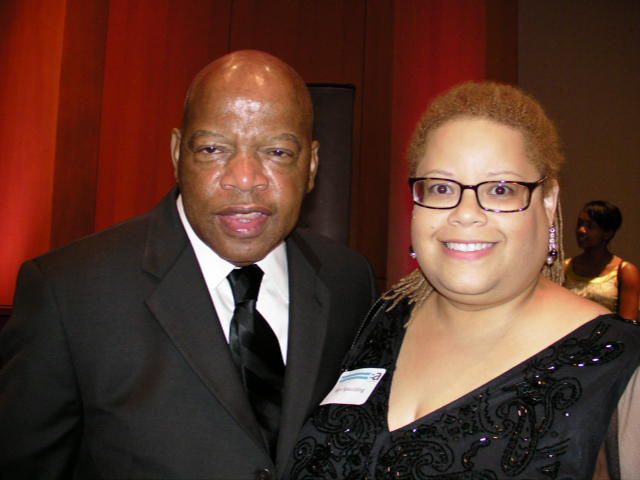
Last Saturday I had the incredible opportunity to hear civil rights legend Congressman John Lewis speak. This man of deep faith and principle has shed blood, has been beaten unconscious and risked his life and limb repeatedly during the civil rights movement. He never hesitated, and the safety stakes were a helluva lot higher. John Lewis believes in full equality for the LGBT community and walks the walk. Congressman Lewis recalled standing at the Lincoln Memorial where he stood with Dr. Martin Luther King. When Lewis took his turn at the podium, he said:
"You tell us to wait, you tell us to be patient. We cannot wait; we cannot be patient. " You want your freedom and you want it now.
No government, be it federal or state, should tell a person who you can marry or who you cannot marry. You have a right to fall in love and get married.
So our struggle is all one struggle. It is not a struggle that lasts just for one day, one week, or one month or one year. It is a struggle of a lifetime, to build a beloved community. A community at peace with itself that recognizes dignity and the worth of every human being.
But perhaps the most powerful message was to those in the LGBT community who are waiting for equality to come to them -- Lewis charged us to seize the moment, to not accept being told to wait your turn, it's time to demand your rights through your representative, and most of all take personal responsibility -- the message we all heard was loud and clear.
Too many people in our community are in the closet waiting for someone else to do the heavy lifting and LEAD. Many of us work for private businesses or institutions that provide protection from being fired for being openly gay, yet so many are still in the closet. They are socially out on the weekends, but have no interest in being out during the week.
They don't want to get active in even the most politically benign way -- but are keen to show up at events like Pride or a club, but have no interest in lobbying their state legislator -- that's considered too "political" or becoming an "activist. " I'm sure we have thousands here today. At that Equality NC's Day of Action a record was broken this year because 200 people showed up. We can do better than this; I know we can.
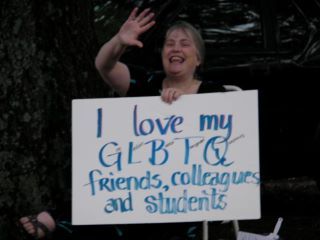
In closing I just want to say thank you. . .
There are many people who don't feel ready to come out of the closet. If you can do so without a threat to your job, education or a roof over your head, you need to wait until the time is right for you. I thank you in advance of kicking that door open for embarking on that personal journey of self-discovery.
* For some of you, this may be your first Pride, your first tentative step out of the closet. Thank you for being here.
* For some of you, this is one of the few public LGBT events you attend and feel free to be out. Thank you for being here.
* For some not here today, you are family and friends who support and love the LGBT people in your life, but can't quite get there to be a public ally. I thank you in advance for asking "What can I do to support you" to take that next step.
* For some of you, you are here for us as allies, publicly out and committed to openly working for equality. Thank you for being here.
* For a good number of you, you are out at work, out to your family and enjoy the freedom of being true to yourself. Thank you for being here. If you haven't already, head over to the Equality NC table and sign up so you can attend the next Day of Action. I'll see you there. Let's make a difference here in NC.
Thank you, and enjoy the rest of Pride weekend! See you on the Internet!
It was an amazing evening with many old and new friends at Equality Alabama's Gala Saturday night. The highlight was keynote speaker Rep. John Lewis (D-GA), who is a native of Troy, Alabama. His played a legendary fearless role in the civil rights struggles of the 60s -- and he is man who believes in LGBT civil equality with equal conviction -- he immediately signed on to DOMA repeal legislation.
This is significant in a day when there is a clear dearth of support in the religious black community; Lewis has the moral standing that a homophobe in the pulpit like Bishop Harry Jackson can never touch. John Lewis took batons to the head, was beaten to unconsciousness multiple times for equality -- courage and moral conviction that Jackson and his fellow charlatans of bigotry are bereft of.
Rep. Lewis spoke eloquently about the simplicity of the government staying out of the lives of gay and lesbian couples -- there is no need to "save" marriage from two people who simply want to love one another and be legally affirmed in the same way that heterosexual couples are when they marry.
But perhaps the most powerful message was to those in the LGBT community who are waiting for equality to come to them -- Lewis charged us to seize the moment, do not accept being told to wait your turn, to demand your rights through your representative, and most of all take personal responsibility -- the message we all heard was loud and clear. Too many LGBTs are in the closet waiting for someone else to do the heavy lifting and LEAD. We are all capable of leading by kicking that closet door open. The main meat of the speech begins around 5:00 -- and you will want to hear it all. The man had the audience spellbound.
John Lewis could have let someone else take the baton to the head for his rights. He didn't; his rights were too important to him to NOT lead by example. I asked State Rep. Patricia Todd thought of his wake up call to our community. She agreed that there is no excuse for our so-called leaders, our elected representatives who say they are our allies but lack the political spine to do the right thing should watch this speech as required education. But we also noted to one another that even more critical was Lewis's call to you - those of us who rail about what someone else can do to lead or move the ball forward and don't step up, or take even small steps to be interested in determining the fate of your civil rights. Where is the fire in the belly of our movement? It's not in DC, it's all of you, if you choose to do a tenth, hell, one-hundredth of what John Lewis showed in terms of personal courage to fight for his rights against hostility day and night. The transcript is here.
How many of you have attended a City Council meeting? I recently attended one and it was interesting in many respects, particularly because I write about national and state politics for my blog.
This meeting drew a standing-room-only crowd to the council chambers. I was there because the members of the council were going to vote on a resolution that would endorse and support "the rights of same-sex couples to share fully and equally in the rights, responsibilities and commitments of civil marriage." Many of my blog's national readers were looking for a first-hand account, so I was there as a citizen journalist.
Finally, the video of one of the interesting panels I was on at Netroots Nation has turned up (sorry no transcript). I did discuss the whole dustup over having to rewrite the Blend's TOS. Lots of fun listening to the trials and tribulations of how women who blog often pay much more attention to maintaining civility on their blogs (and seem to be expected to) whereas blogs by men often are a free for all.
A few years ago, male bloggers 'round the liberal bloglandia were wondering out loud, "Where are the women bloggers?" Many of the women in the feminist and progressive blogospheres responded with frustration—we were there, and had been, the whole time. Today, the blogosphere looks awfully different, as feminist bloggers are increasingly mainstreamed and able to exert stronger influence on online discourse. But "blogging while feminist" isn't always easy, and feminist bloggers have faced harassment and threats that are uniquely gendered and sexualized. Feminists who have been most successful at running bigger blogs have also been mostly young, white, heterosexual and middle-class—so their issues have been presented to the mainstream progressive movement as the whole of feminism. This panel will look at what has changed, what hasn't and who remains on the edges of progressive blogging. It will also examine how female bloggers—and feminist bloggers in particular—are treated in mainstream spaces, and what we can do about it.
 It's coming up soon! Tickets are available. Hopefully, given my health issues, I will survive the airplane trip in one piece in order to receive this distinguished award.

 It has been surprising how much mail I've received here and on Facebook from readers regarding my open discussion about
 You'll recall that the 2004 election year was an unending assault on our lives with professional anti-gay organizations working hard to ensure amendments passed in states to bar gay and lesbian couples from marrying. And passed they did at the ballot box, in Missouri, Montana, Mississippi, Alabama, Arkansas, Georgia, Kentucky, Louisiana, North Dakota, Ohio, Oklahoma, Michigan and Utah. A clean, depressing sweep.
  When you encounter someone who cites their religious beliefs to justify opposing the civil right of gay and lesbian couples to marry, ask them a couple of questions. 1) Do you realize that unless the couple has obtained a marriage license issued by the state, a religious marriage means nothing in the eyes of the law? 2) Do they truly believe that there isn't separation of church and state in this matter? If so, they are effectively asking the state not just to prevent us from marrying on that basis,they are also affirming state discrimination against the churches and denominations that DO want to marry those same couples. That's discrimination based on religion and I hate to break it to them -- that isunconstitutional.
  What this lack of cross-community dialogue means for out LGBTs of color is that one has to be willing to put yourself out there to be attacked, over and over for addressing homophobia in communities of color knowing that few, if any, white LGBTs are going to come forward to have your back.
  In closing I just want to say thank you. . .

 My column is up: "
 This meeting drew a standing-room-only crowd to the council chambers. I was there because the members of the council were going to vote on a resolution that would endorse and support "the rights of same-sex couples to share fully and equally in the rights, responsibilities and commitments of civil marriage." Many of my blog's national readers were looking for a first-hand account, so I was there as a citizen journalist.